Online International Conference “Sixty Years of the International Covenants on Human Rights”

IPSA RESEARCH COMMITTEE 26 ON HUMAN RIGHTS

Interim Conference 2026 · Online

Sixty Years of the International Covenants on Human Rights

Civil and Political Rights · Economic, Social and Cultural Rights (1966–2026)

Online International Conference

Human Rights Day

16 December 2026

CALL FOR PAPERS

On 16 December 1966 the United Nations General Assembly adopted the International Covenant on Civil and Political Rights (ICCPR) and the International Covenant on Economic, Social and Cultural Rights (ICESCR) by resolution 2200 A (XXI). Together with the Universal Declaration of Human Rights, they form the International Bill of Human Rights. Their 60th anniversary is a good reason to reflect on what the Covenants have achieved, what remains unfulfilled, and how they should respond to the challenges of our time.

The decision to adopt two separate treaties reflected deep disagreements about the nature of rights. Civil and political rights were seen as immediately enforceable; economic, social and cultural rights, as goals to be realised progressively. United Nations bodies have long defended the universality, indivisibility and interdependence of all human rights, yet these characteristics are still contested in theory and unevenly honoured in practice.

Regarding civil rights, technology raises new problems for freedom of expression, privacy and equality. Some argue that old concepts must be partly redefined, while others call for entirely new approaches. Concerning political rights, citizens’ disaffection with politics is growing, democratic institutions are under strain, and there is a demand for more deliberation, participation and accountability. Political rights must be understood within the framework of a democracy of quality.

With regard to economic and social rights, their entitlement and full enforcement remain controversial: should they be universal or targeted at those in need, how far are they justiciable, and what is the relationship between liberal rights and social rights? In relation to cultural rights, the position of minorities differs across societies but is often framed as a struggle against assimilation, while the recognition of differentiated identities may face criticism from the standpoint of autonomy or gender equality.

The Interim Conference of the IPSA Research Committee 26 on Human Rights invites scholars from political science, law, philosophy, sociology, international relations and related disciplines, as well as practitioners, to discuss these questions. Theoretical, doctrinal, empirical and comparative contributions are equally welcome, as are proposals from early-career researchers and doctoral students.

PANELS

The conference will be organised in six panels. Each panel will have a Chair and a Discussant.

Panel 1Sixty years of the Covenants: history, legacy and indivisibilityThe drafting history and the decision to split the Universal Declaration into two treaties; the Cold War divide between “liberty” and “equality” rights; the doctrine of universality, indivisibility and interdependence from Tehran (1968) and Vienna (1993) to today; and whether the Covenants still provide a shared normative language in a fragmented international order.
Panel 2Civil rights in the digital ageFreedom of expression, hate speech and disinformation; privacy, data protection and surveillance; artificial intelligence and algorithmic decision-making; freedom of thought, conscience and religion; equality and non-discrimination under the ICCPR and the case law of the Human Rights Committee.
Panel 3Political rights and the quality of democracyArticle 25 ICCPR and the right to take part in public affairs; democratic backsliding and emergency powers; deliberation, participation and the accountability of political leaders; elections and the digital public sphere; the political rights of migrants and other non-citizens.
Panel 4Economic and social rights: from aspiration to enforcementProgressive realisation, minimum core obligations and maximum available resources; justiciability and the Optional Protocol to the ICESCR; health, housing, education, work and social security; austerity, poverty and inequality; universal entitlement versus targeting those in need; the costs of rights.
Panel 5Cultural rights, minorities and identityArticle 27 ICCPR and Article 15 ICESCR; minorities, Indigenous peoples and the right to take part in cultural life; recognition, assimilation and the limits of accommodation; tensions between group rights, individual autonomy and gender equality; language, religion and cultural heritage.
Panel 6Monitoring, compliance and the future of the human rights treaty systemThe Human Rights Committee and the Committee on Economic, Social and Cultural Rights; individual communications, state reporting and treaty body reform; regional systems and domestic courts as enforcers of Covenant rights; the 2030 Agenda and the Sustainable Development Goals; climate change, migration and new challenges for the next sixty years.

SUBMISSION OF ABSTRACTS

  • Abstracts of up to 400 words in English, indicating the preferred panel, together with the author’s name, affiliation, e-mail address and a short biographical note (up to 100 words).
  • Abstracts and any queries should be sent to humanrights@webphilosophia.com with the subject line “RC26 Interim Conference 2026”.
  • Each participant may present one paper as first author. Co-authored papers are welcome.

IMPORTANT DATES

Deadline for abstracts22 November 2026
Notification of acceptance29 November 2026
Publication of the programme1 December 2026
Online conference16 December 2026
Deadline for full papers (special issue)30 March 2027

FORMAT AND PARTICIPATION

The conference will be held entirely online. Each presentation will last about 15 minutes, followed by the Discussant’s comments and an open debate. Sessions will be scheduled in Central European Time (CET, UTC+1), taking into account the time zones of the participants. Connection details will be sent to the speakers and to registered attendees before the conference. Participation is free of charge.

PUBLICATION: SPECIAL ISSUE OF THE JOURNAL OF GLOBAL HUMAN RIGHTS

Selected papers presented at the conference will be considered for publication in a special issue of the Journal of Global Human Rights devoted to the 60th anniversary of the Covenants. Full papers must be submitted through the journal’s online system and will undergo the journal’s ordinary peer review. Presentation at the conference does not guarantee publication.

About the journal. The Journal of Global Human Rights is an international, interdisciplinary journal that publishes original research on human rights from philosophy, law, political science, sociology and related fields. This journal is affiliated with IPSA Research Committee 26 (Human Rights). Its main features are:

  • Scope: normative foundations of human rights; democracy, constitutionalism and the rule of law; equality, minorities and vulnerable groups; freedom of expression and the digital public sphere; international and regional human rights systems; and human rights in times of crisis, conflict and technological change.
  • Peer review: research articles undergo double-anonymous peer review by at least two independent reviewers.
  • Open access, no fees: articles are published in immediate open access under a Creative Commons licence. There are no submission fees and no article processing charges, and authors retain copyright.
  • Persistent identifiers and ethics: every article receives a DOI through Crossref, and the journal follows COPE guidelines on publication ethics, including a policy on the disclosure of generative AI use.
  • Periodicity and language: biannual, published in English (British or American spelling, used consistently). The first issue (Vol. 1, No. 1) appeared in 2026.
  • Author guidelines: research articles of 6,000–12,000 words; abstract of up to 250 words and 5–8 keywords; references in APA 7th edition; anonymised manuscript, title page and biographical note submitted as separate files, using the journal’s templates.

Website: journalglobalhumanrights.webphilosophia.com

ORGANISATION

Research Committee 26 on Human Rights, International Political Science Association (IPSA). Website: rc26.ipsa.org

In collaboration with the Journal of Global Human Rights.

Link to connect:

https://eu.bbcollab.com/guest/7953ad9a23764c30bafa7044498ce380

Rome 2027 IPSA World Congress RC26 Open Panels

1. Artificial Intelligence, Human Rights and the Uncertain Future of Democracy

Convenor: Dr. Alex Sander Xavier Pires

Chair: Dr. Anju Gupta

Discussant: Dr. Oscar Perez de la Fuente

ID: PL-4494

Panel: https://www.ipsa.org/wc/panel/artificial-intelligence-human-rights-and-uncertain-future-democracy

2. Artificial Intelligence, Surveillance, and Human Rights: Governance Challenges in Uncertain Democracies

Convenor: Prof. Cássius Guimarães Chai

Chair: Mr. Furqan Ahmed

Discussant: Prof. Carla Teixeira

ID: PL-3971

Panel: https://www.ipsa.org/wc/panel/artificial-intelligence-surveillance-and-human-rights-governance-challenges-uncertain

3. Biometric States and Digital Surveillance: Human Rights in an Age of Datafied Governance

Convenor: Dr. Sumant Kumar

Chair: Dr. Sumant Kumar

Co-chair: Dr. Keerthiraj S

Discussant: Dr. Arvind Shukla

ID: PL-4137

Panel: https://www.ipsa.org/wc/panel/biometric-states-and-digital-surveillance-human-rights-age-datafied-governance

4. Climate Change as a Human Rights Crisis: Justice, Accountability, and Future Generations

Convenor: Dr. Sumant Kumar

Chair: Dr. Priyadarsini Sahu

Discussant: Dr. Sumant Kumar

ID: PL-4140

Panel: https://www.ipsa.org/wc/panel/climate-change-human-rights-crisis-justice-accountability-and-future-generations

5. Disinformation and Human Rights: Challenges for Democracy, Governance and the Rule of Law

Convenor: Dr. Alex Sander Xavier Pires

Chair: Dr. Alex Sander Xavier Pires

Co-chair: Prof. Jędrzej Skrzypczak

Discussant: Prof. Cássius Guimarães Chai

ID: PL-4044

Panel: https://www.ipsa.org/wc/panel/disinformation-and-human-rights-challenges-democracy-governance-and-rule-law

6. Education for Peace, Democracy and Human Rights: Global Challenges and New Perspectives

Convenor: Dr. Alex Sander Xavier Pires

Chair: Dr. Alex Sander Xavier Pires

Co-chair: Prof. Cássius Guimarães Chai

Discussant: Prof. Jędrzej Skrzypczak

ID: PL-4043

Panel: https://www.ipsa.org/wc/panel/education-peace-democracy-and-human-rights-global-challenges-and-new-perspectives

7. Governing Digital Speech: Political, Legal, and Moral Perspectives on Platform Regulation

Convenor: Dr. Oscar Perez de la Fuente

Chair: Prof. Jędrzej Skrzypczak

Discussant: Dr. Oscar Perez de la Fuente

ID: PL-4466

Panel: https://www.ipsa.org/wc/panel/governing-digital-speech-political-legal-and-moral-perspectives-platform-regulation

8. Human Rights at a Crossroads: Political Uses of Universalism in Times of Contestation

Convenor: Dr. Irene Lizzola

Chair: Dr. Lison Guignard

Co-chair: Mrs. Louise Cadorel

Discussant: no figura en la ficha pública

ID: PL-4458

Panel: https://www.ipsa.org/wc/panel/human-rights-crossroads-political-uses-universalism-times-contestation

9. Human Rights in an Age of Polycrisis: Navigating Intersecting Threats to Dignity and Democracy

Convenor: Dr. Anju Gupta

Chair: Prof. Cássius Guimarães Chai

Co-chair: Prof. Jędrzej Skrzypczak

Discussant: no figura en la ficha pública

ID: PL-3967

Panel: https://www.ipsa.org/wc/panel/human-rights-age-polycrisis-navigating-intersecting-threats-dignity-and-democracy-0

10. Human Rights in the Age of Neoliberal Framework: Reconciling Irreconcilables

Convenor: Prof. Raj Kumar Kothari

Chair: Prof. Biswanath Chakraborty

Co-chair: Dr. Tulika Chakravorty

Discussant: Ms. Srimanti Sarkar

ID: PL-4000

Panel: https://www.ipsa.org/wc/panel/human-rights-age-neoliberal-framework-reconciling-irreconcilables

11. Human Rights in Uncertain Democracies: Rethinking Governance in Asia with Special Reference to India

Convenor: Prof. Abinash Kumar

Chair: Prof. Dr. Mamta Chandra Shekhar

Discussant: no figura en la ficha pública

ID: PL-4233

Panel: https://www.ipsa.org/wc/panel/human-rights-uncertain-democracies-rethinking-governance-asia-special-reference-india

12. Life in Truth: The Legacy of Charter ’77 and Human Rights-based Dissent in Times of Democratic Backsliding

Convenor: Dr. Dagmar Kusa

Chair: Dr. Dagmar Kusa

Co-chair: Dr. Sylvia Tiryaki, JD

Discussant: Prof. James Griffith

ID: PL-3944

Panel: https://www.ipsa.org/wc/panel/life-truth-legacy-charter-77-and-human-rights-based-dissent-times-democratic-backsliding

13. Privatisation of Censorship and the Commercialisation of Propaganda in the Age of Big Platforms

Convenor: Prof. Jędrzej Skrzypczak

Chair: Dr. Oscar Perez de la Fuente

Discussant: Prof. Jędrzej Skrzypczak

ID: PL-4486

Panel: https://www.ipsa.org/wc/panel/privatisation-censorship-and-commercialisation-propaganda-age-big-platforms-rethinking

14. Shrinking Civic Space: The Global Crackdown on Dissent, NGOs, and Human Rights Defenders

Convenor: Dr. Sumant Kumar

Chair: Dr. Shreesh Kumar Pathak

Co-chair: Dr. Priyadarsini Sahu

Discussant: Dr. Sumant Kumar

ID: PL-4139

Panel: https://www.ipsa.org/wc/panel/shrinking-civic-space-global-crackdown-dissent-ngos-and-human-rights-defenders

15. State Power and Impunity: Custodial Violence, Majoritarianism, and the State of Exception

Convenor: Dr. Sumant Kumar

Chair: Miss Simran Dua

Co-chair: Ms. Ankita Suman

Discussant: Ms. Ishita Maity

ID: PL-4141

Panel: https://www.ipsa.org/wc/panel/state-power-and-impunity-custodial-violence-majoritarianism-and-state-exception

16. Statelessness, Displacement, and the Rights of the Excluded: Rethinking Protection Regimes

Convenor: Dr. Sumant Kumar

Chair: Dr. Arvind Shukla

Co-chair: Dr. Sumant Kumar

Discussant: Ms. Ishita Maity

ID: PL-4138

Panel: https://www.ipsa.org/wc/panel/statelessness-displacement-and-rights-excluded-rethinking-protection-regimes

17. Weaponized Interdependence: Sanctions, Supply Chains, and the Geoeconomics of Rivalry

Convenor: Dr. Sumant Kumar

Chair: Dr. Shreesh Kumar Pathak

Co-chair: Ms. Ishita Maity

Discussant: Dr. Sumant Kumar

ID: PL-4145

Panel: https://www.ipsa.org/wc/panel/weaponized-interdependence-sanctions-supply-chains-and-geoeconomics-rivalry

18. Who Belongs? Minorities, Human Rights and the Future of Democratic Inclusion

Convenor: Dr. Alex Sander Xavier Pires

Chair: no figura en la ficha pública

Discussant: Dr. Anju Gupta

ID: PL-4495

Panel: https://www.ipsa.org/wc/panel/who-belongs-minorities-human-rights-and-future-democratic-inclusion

.

Conference on 40th Anniversary of Right of Peoples to Peace To commemorate Human Rights Day

Objectives

At the same time, the year 2024 marks forty years since the Declaration on the Right of Peoples to Peace (A/RES/39/11, 11 November 1984) and the preparation for the International Year of Peace and Trust, 2025 (A/RES/78/266), both resolutions being directly linked to the development of human rights in an environment of awareness for peace against violence.

Considering the current moment of global political instability with repercussions in all areas of the social and intellectual domain, it is proposed that the “Conference on the Right of Peoples to Peace” be held, allowing for a broad debate on issues related to the theme, such as, for example, the culture of peace, sense of peace in restricted system, human rights, democracy and governance, documenta)on and methods, education, etc.

Joint Project
a) Universidade Autónoma de Lisboa (Autonomous University of Lisbon)
b) RC#26 on Human Rights from IPSA
c) Uniwersytet im. Adama Mickiewicza w Poznaniu (Adam Mickiewicz University in
Poznań)
d) Universidad Carlos III de Madrid (University Carlos III of Madrid)
e) South Asia Research Institute for Minorities — SARIM

Scientific Board
Prof. Dr. Jedrzej Skrzypczak, Adam Mickiewicz University in Poznan and Chair of RC26 on Human Rights IPSA

Prof. Dr. Oscar Perez de la Fuente, Universidad Carlos III de Madrid and Vice-Chair of RC26 on Human Rights IPSA

Prof. Dr. Alex Sander Pires, Universidade Autónoma de Lisboa and Chair-Elect of RC26 IPSA

Date
10 December 2024, between 19h and 22h (Lisbon Time)
System
Hybrid.

Schedule
19:00 — 19:10: Opening.
Prof. Dr. Alex Sander Pires, Universidade Autónoma de Lisboa and Chair-Elect of RC26 IPSA

19:10 —19:30: Dr. Patrice Vahard, Director of BCNUDH BUREAU CONJOINT DES NATIONS UNIES AUX DROITS DE L’HOMME

“UBUNTU in its relation to peace and its values.”

19:30 — 19:45: Prof. Dr. Jedrzej Skrzypczak, Adam Mickiewicz University in Poznan and Chair of RC26 on Human Rights IPSA

“The right of people to peace in the pre-war period: 40th anniversary of UND
Declaration.”

19:45 — 20:00: Prof. Dr. Oscar Perez de la Fuente, Universidad Carlos III de Madrid and Vice-Chair of RC26 on Human Rights IPSA

“Peace, war, law and Politics.”

20:00 — 20:15: Prof. Dr. José António Frías Montoya, Universidad de Salamanca

“Documentation in Human Rights (in Spanish/en Español).”

20:15 — 20:30: Prof. Dr. Anju Gupta, JECRC University and Member of RC26 IPSA Board

“Women’s rights and gender equality in South Asia.”

20:30 — 20:45: Prof. Dr. Alexandre Miguel Mestre, Universidade Autónoma de Lisboa

“Olympic truce and the peace of peoples.”

20:45 — 21:00: Dr. Furqan Ahmed, South Asia Research Ins)tute for Minori)es and Secretary of RC26 IPSA Board

“Religious Nationalism as a Threat to the Right to Peace in Digital Spaces:
defending minorities on social media.”

21:00 — 21:15: Prof. Dr. Deepak Mewada, JECRC University

“Human Rights Day: Reflecting on progress and challenges.”

21:15 — 21:30: Prof. Dr. Lier Pires Ferreira, Universidade do Estado do Rio de Janeiro

“Peace in times of hegemonic rupture (In Portuguese / Em Português).”

21:30 — 21:45: Prof. Carlos Imbrosio Filho, Universidade Autónoma de Lisboa

“From right to peace to R2P: bridging aspirantions and obligations in preventing atrocities and nuclear catastrophes.”

21:45 — 22:00: Final Remarks and closure

Artificial intelligence and human rights

Beyond Europe – RC26 session “AI and Human Rights. UN Human Rights Day – part1
” (12 December 2024, 15.15-16.45)

Chair: Prof. Jedrzej Skrzypczak (AMU, RC26 IPSA chair)
Keynote speaker:

  1. Ph.D. Francisco Bariffi (University Carlos III of Madrid) fbariffi@der-pu.uc3m.es,
    o AI and Human Rights in Global Governance: Safeguarding Vulnerable Groups in the Age of Emerging Technologies

  1. Francesco Cirillo, Postdoctoral Researcher, University of Tuscia, Viterbo (Italy), francescocirillostudio@gmail.com
    • AI and Cognitive Manipulation: Are European Legislators Chasing Shadows?
  2. Marco Marsili, Research Institute for International Studies, Department of Philosophy and Cultural Heritage, Cà Foscari University of Venice, Italy.
    • Navigating the Future: Human Rights Implications of Artificial Intelligence”.
  3. dr. Dorottya Biczi (Széchenyi István University Doctoral School of Law and Political Sciences, Department of Constitutional Law and Political Science, bdorottya2000@gmail.com)
    • The potential impact of artificial intelligence on fundamental rights.

Discussants: Furqan Ahmed (South Asia Research Institute for Minorities SARIM, Karachi, Pakistan, Secretary of RC26 Board) Prof. Ewa Szewczyk (Uniwersytet Zielonogórski, Poland)

Beyond Europe – RC26 session 2“AI and Human Rights”. UN Human Rights Day – part 2

 (12 December 2024, 17.00-18.30 Warsaw/Madrid time)

Chair: Prof. Cassius Guimaraes Chai, (Universidade Federal do Maranhão /PPGDIR/Law/ /PPGAERO/Aerospace Engineering/ and Faculdade de Direito de Vitória (PPGD/Law), member of RC26 IPSA Board)

  1. Prof. Jedrzej Skrzypczak (AMU)

Challenges for freedom of expression and pluralism of opinion in the EU arising from the development of artificial intelligence

  • R.Karmegam Ph.D, Research Scholar (Full Time) Department of Political Science & Public Administration, Annamalai University, Chidambaram, TamilNadu, India-608002

            Dr.D.Sivakumar Associate Professor, Department of Political Science & Public Administration, Annamalai University,  Chidambaram, Tamil Nadu,India        

S.Sharmila Devi Associate Professor, Department of Political Science & Public Administration, Annamalai University,  Chidambaram, Tamil Nadu,India 

  • ARTIFICIAL INTELLIGENCE IN INTERNATIONAL RELATIONS AND COMMUNICATION: Technologies, Diplomacy,  Algorithms.
  •  S.Sharmila Devi Ph.D, Research Scholar (External) Department of Political Science & Public Administration, Annamalai University, Chidambaram, TamilNadu,India

            Dr.M.Jeyabrabha Assistant Professor, Department of Political Science & Public Administration, Annamalai University,  Chidambaram, Tamil Nadu,India

R.Karmegam Ph.D, Research Scholar (Full Time) Department of Political Science & Public Administration, Annamalai University, Chidambaram, Tamil Nadu,India

  • ARTIFICIAL INTELLIGENCE IN INTERNATIONAL RELATIONS AND COMMUNICATION: Global Diplomacy, Conflict Management and Global Inequality.
  •  Hokstok, Kinga Nagyné (PhD student, Széchenyi István University’s Doctoral School of Law and Political Sciences, Judge, Administrative Division of the Győr Regional Court)
  • The impact of the use of artificial intelligence in the workplace on the right to safe work
  • Prof. Ravisankar R S (Assistant Professor, Department of Political Science,  NSS College, Pandalam.(affiliated to the University of Kerala, India.)
  • Artificial Intelligence (AI), Surveillance State and the Human Rights Jeopardy

Discussant: Prof. Oscar Pérez de la Fuente, (Carlos III University of Madrid, vice-chair of RC26 IPSA),

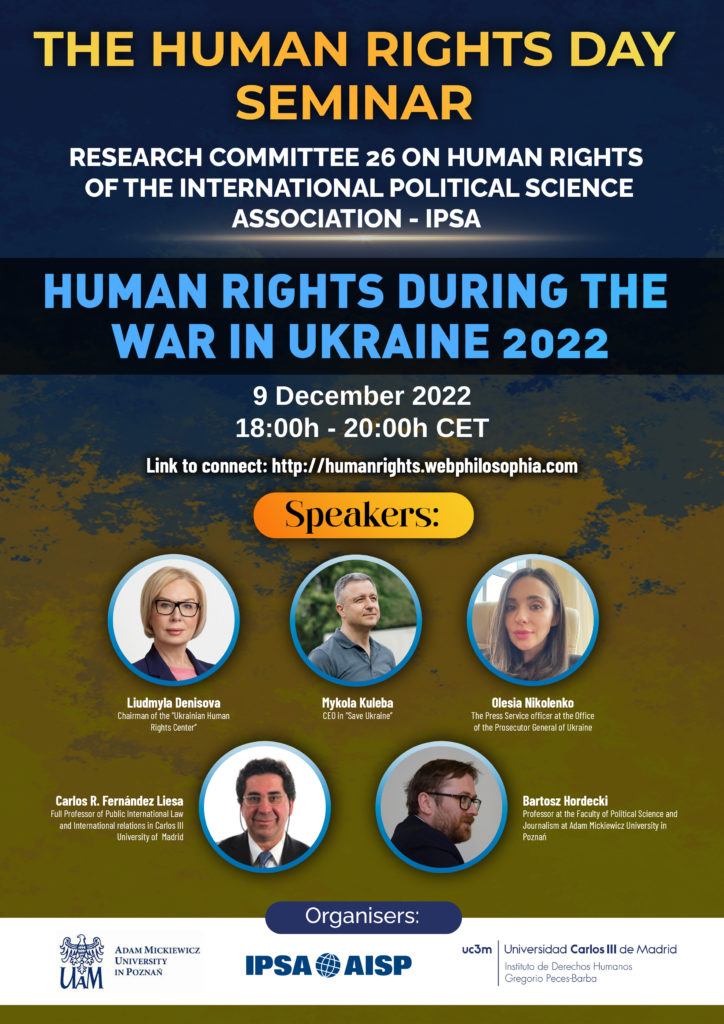
Human rights day seminar 2022

The Human Rights Day Seminar

Research Committee 26 on Human Rights of the International Political Science Association – IPSA

9 December 2022, 18.00-20.00 CET

HUMAN RIGHTS DURING THE WAR IN UKRAINE 2022

Moderators:

Oscar Pérez de la Fuente

Chair IPSA RC26 on human rights

Jedrzej Skrzypczak

Chair-elect IPSA RC26 on human rights

Speakers:

Olesia Nikolenko 

She is graduated from the Institute of Journalism at National Taras Shevchenko University of Kyiv and the Faculty of Political Science and Journalism at Adam Mitskievich University in Poznan.

Works with the press service at the Office of the Prosecutor General of Ukraine.

Mykola Kuleba

  • CEO in “Save Ukraine”
  • Ombudsman for Children with the President of Ukraine (2014-2021)

Liudmyla Denisova

  • Chairman of the Non-Governmental Organization “Ukrainian Human Rights Center” 
  • Former Ukrainian Parliament Commissioner for Human Rights
  • Former Minister of Social Policy of Ukraine

Carlos R. Fernández Liesa

He is Professor of Public International Law and International Relations at the Carlos III University of Madrid since 2005. He has directed the Mario Villarroel Chair of International Humanitarian Law and Human Rights (since 2011). He is a member of the expert role, appointed by Spain, of the Moscow Mechanism of the Organisation for Security and Cooperation in Europe (2022-2028). He is the director of the expert degree in international crisis prevention and management that is made between the Francisco de Vitoria Institute of International and European Studies and the Army War College.
He was one of the researchers responsible for the collection on the history of human rights which resulted in 24 volumes, with more than 200 authors. He is the coordinator of the subject International Protection Systems in the official master’s degree in human rights UC3M. At UC3M he has been secretary general, vicechancelor of students and European convergence, director of the Francisco de Vitoria Institute of International and European Studies, of the Department of International Law, Ecclesiastical Law and Philosophy of Law, and of the Fernando de los Ríos student residence.

Bartosz Hordecki 

He is Assistant professor at the Faculty of Political Science and Journalism at Adam Mickiewicz University in Poznań, a member of the Executive Board of the Research Committee 50: Politics of Language (International Political Science Association), specialises in studies on language politics and policies, political philosophy and political rhetoric. His research also concerns the evolution of political and legal cultures as well as transformations of key-concepts and methodological approaches in political and media studies.